
01 / NMD-M03Before you light a fire
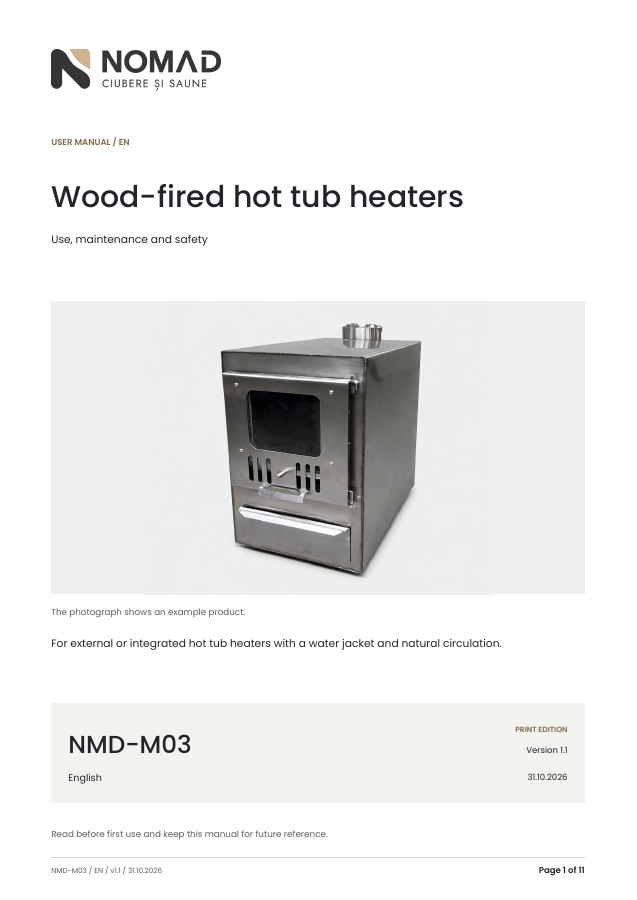
For external and integrated hot tub heaters with a water jacket and natural circulation. Read this manual alongside the hot tub manual. Check the minimum fill level, wood load and safety clearances in the documents supplied with your particular heater.
Water first
Fill and vent the entire water jacket and heater circuit. Keep the tub water above the upper heater connection and at or above the minimum level specified for your product, even when nobody is in the tub. If the required level is unclear, contact NOMAD before lighting.
Keep circulation open
Never heat with blocked connections, kinked hoses, transport plugs, trapped air or frozen water. Do not isolate the heater from the tub while there is fire, embers or residual heat.
Cool before draining
Do not drain, disconnect or move the heater until the fire and embers are fully out and both heater and water have cooled. No visible flame does not mean the heater is cold.
Outdoors only
Use in the open air, with smoke discharged away from people, windows and air intakes. Do not operate in a room, tent or enclosed structure. A responsible adult must supervise the fire throughout.
02 / NMD-M03How the double wall works
The fire heats the firebox metal, which transfers heat to the water. In a water-jacketed heater, a water-filled space sits between the firebox wall and the outer casing.
Two separate paths
Wood burns in the firebox and combustion gases leave through the flue. Water stays in the jacket and tub circuit. Water must not enter the firebox and smoke must not enter the water circuit. In the usual direct arrangement, the tub water itself flows through the heater; there is no separate heat-transfer fluid.
Natural circulation
Heated water becomes less dense, rises and returns to the tub through the upper connection. Cooler water enters through the lower connection. This density difference drives circulation without a dedicated pump, provided the installation is correct and the route is clear.
What double-walled does not mean
The water jacket is not burn-proof insulation or permission to pressurise the heater. The door, flue and areas without direct water cooling can become extremely hot. A flue guard does not make the flue safe to touch. A twin-wall insulated flue is a different component with its own requirements.
03 / NMD-M03Installation and cold checks
A competent person must check the installation before first use. Take dimensions, hose gradients, diameters and clearances from the actual heater instructions, not the principle diagram.
External heater
Place it on a stable, level, heat-resistant base at the specified position and height. Connect lower to lower and upper to upper, following the product markings. Do not cross, restrict or route hoses so that air collects. Do not extend the pipework or reduce its bore without supplier approval.
Integrated heater
Check access to the door, drains and service points, protection of the shell and any hidden connections. Do not remove guards or casing panels to operate it. An immersed heater inside the tub requires its own fill-level, barrier and loading instructions; the external layout shown here is not its installation plan.
Fire protection
Provide suitable non-combustible protection beneath and in front of the firebox. Observe the specified clearances for the heater, flue and terminal from timber, roofs, trees, furniture and fabrics. Do not improvise a flue penetration through a roof. A heat shield or spark arrestor does not cancel required clearances.
Cold-water check
Remove packaging and transport plugs; check grates, internal parts, flue, clamps and guards. With the heater cold, close the required drains, fill and vent as instructed for the model. Check for a stable level and leaks. Correct every defect before lighting.
04 / NMD-M03Lighting, step by step
Start only after checking the water level, circuit and location. Keep children and combustible objects away from the heater.
1. Prepare the cold firebox
Remove cold ash that obstructs the air supply or grate. Fit every required internal part. Check that the flue route is clear. Never operate with a missing or damaged flue.
2. Use the right fuel
Use dry, split, untreated firewood of a size permitted for the firebox. Do not burn waste, chipboard, painted or treated timber. Never use petrol, diesel, alcohol or liquid accelerants. Coal and pellets are not automatically suitable for a wood-fired heater.
3. Light a controlled fire
Use kindling and a solid firelighter only if permitted for your heater. Arrange fuel without blocking airflow or exceeding the permitted load. Set the air controls to the model's lighting position. There is no single control setting that suits every heater.
4. Close and watch
Once the fire is established, keep the door closed except for operations specified in the heater manual. Do not leave the ash drawer open to force the draught. Watch the water temperature and normal circuit operation; never test hot connections with your hand.
5. Refuel safely
Wear suitable heat-resistant gloves. Open the door slowly from the side, keeping your face away. Add a modest load, then close the door. If smoke continues to spill towards the operator, stop refuelling, follow the shutdown procedure and investigate once cold.
05 / NMD-M03Heating and normal shutdown
A wood fire does not switch off instantly. Fuel, embers and hot metal keep transferring heat after the last load.
Measure the water
Water forms layers at different temperatures. Mix it safely and use a thermometer in several places, away from the hot return. Your hand is not a thermometer, and one sensor may not represent the whole tub. The heater return is a scalding hazard.
Reduce the fire early
As the water approaches the intended temperature, use smaller loads and then stop adding wood. Adjust only the designed air controls, as directed for the heater. Do not block the flue or improvise dampers to extinguish the fire. Keep supervising with the circuit full and unrestricted.
Before bathing
Stay out during lighting, refuelling or any fault. Enter only when the temperature is even, within the tub's limits and all guards are in place. Never exceed 40 °C or the product's lower limit; this is an upper limit, not a suitable bathing temperature for everyone. Keep clear of the hot return and heater parts.
Normal shutdown
Stop adding wood and allow the fuel to burn down in a controlled way, following the heater instructions. Maintain the water level and circulation until the fire is fully out and the system is cool. Never control temperature by draining or disconnecting the heater. Do not routinely extinguish the fire by pouring water into the firebox.
06 / NMD-M03Draining, winter and maintenance
Drain and clean only when the heater is cold. Another component's frost-protection setting does not guarantee protection of the heater jacket or hoses.
Drain the whole circuit
Confirm that the fire and embers are out and both water and heater have cooled. Open the tub, heater and low-point drains as required by the installation. Check the jacket separately: an empty tub does not prove an empty heater. If connections must be removed, follow the cold-service procedure.
Before freezing weather
Do not leave water in any heater, hose or cavity that can freeze. If adequate continuous protection cannot be confirmed, stop use and drain fully after cooling, before frost arrives. Leave drains in the model's specified storage position. Never add automotive antifreeze to bathing water.
Ash, soot and flue
Once cold, remove ash into a lidded metal container on a non-combustible surface away from buildings. Clean the grate, firebox and gas passages at the specified intervals, sooner if draught deteriorates. Have the flue and deposits checked and cleaned by a competent person.
Water jacket and materials
Deposits can impair heat transfer and circulation. Use only cleaning methods and products approved for the metal, seals and tub. Do not mix chemicals, dose concentrates into heater connections or use carbon-steel brushes on stainless steel. Check the water-treatment limits for your heater before adding salt or chlorine-based products.
Routine inspection
When cold, check for corrosion, distortion, damage to accessible welds, worn seals, hoses and clamps. Do not weld or modify the heater without approval and competent inspection. Arrange an inspection after freezing, boiling or dry firing, before lighting again.
07 / NMD-M03Faults and emergencies
Stop adding wood whenever operation is abnormal. Never loosen a hot connection or release pressure by undoing hose clamps.
Boiling, steam, hammering or violent return flow
Keep people away from the heater and return. Stop adding fuel. If safe to do so, close the door and reduce the adjustable air supply as specified; do not block the flue. Do not drain, isolate, disconnect or add cold water to a possibly dry heater. Get help; call 112 for immediate danger or fire. Have the installation checked after cooling, before reuse.
Low water, a major leak or hot dry heater
Keep away from connections and do not immediately refill. Stop adding fuel, clear the area and allow supervised cooling without actions that could release steam or hot water. Refill and restart only after cooling and inspection.
Persistent smoke or poor heating
Do not compensate with more wood. Once shut down and cold, check wet fuel, ash, deposits, flue, air supply and circuit installation. Wind and siting can affect draught. Do not guess at changes to flue height or pipework.
Moisture in the firebox
Condensation may form when heating starts with cold water. Persistent leakage, a crack or a falling tub level must not automatically be dismissed as condensation. Stop use and arrange an inspection if the cause is uncertain.
Fire or suspected carbon monoxide
Leave the area; do not risk your safety to save equipment. For fire, hazardous smoke, or headache, dizziness or nausea near combustion, move to fresh air and call 112. Do not return or restart until the situation has been checked.
08 / NMD-M03Heater details and support
Complete these details with the person checking the installation. Keep this manual, the product documents and purchase records for future reference and service.
Before leaving
Fire and embers completely out; system cooled; children kept away; no ignition source near ash; drainage or frost protection confirmed. Do not leave a fire burning merely to keep the tub warm.
Contact NOMAD
For support, send the model, serial number, photos and a description of the problem to [email protected] or call +40 745 524 215. Do not dismantle or modify a faulty heater to keep using it.